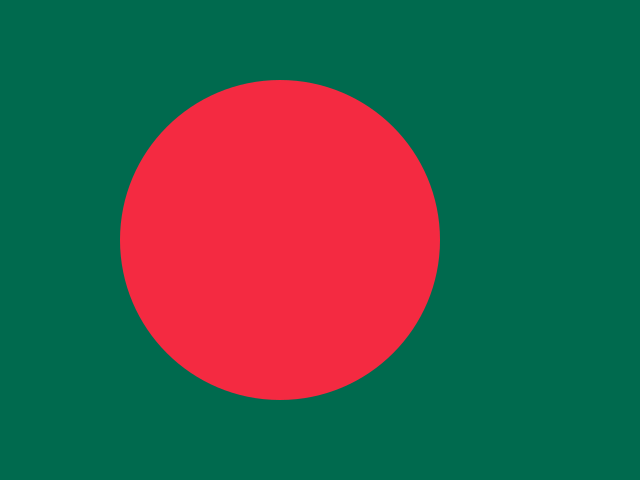
About the Bangladeshi Taka
The Bangladeshi Taka was introduced in 1972, a year after Bangladesh gained independence from Pakistan. It replaced the Pakistani Rupee at par.
The word 'Taka' is derived from the Sanskrit word 'tanka', which was a name for an ancient silver coin.
Interesting Facts
Father of the Nation
Most banknotes of Bangladesh feature a portrait of Sheikh Mujibur Rahman, the 'Father of the Nation' and the first President of Bangladesh.
Unique Taka Symbol
The Taka has its own unique symbol (৳), which is an amalgamation of the Bengali letters for 'Ta' and 'Ka'.
Garment Industry Powerhouse
The value of the Taka is heavily influenced by the country's ready-made garment (RMG) industry, which is one of the largest in the world.
Historical Timeline
Bangladesh Liberation War and independence.
The Taka is established as the national currency.
The first series of banknotes featuring the portrait of Sheikh Mujibur Rahman is issued.
Denominations
Banknotes
Coins
Security Features
Quick Facts
- ISO Code
- BDT
- Symbol
- ৳
- Numeric Code
- 050
- Subunit
- Poisha (1/100)
- Introduced
- 1972-03-04
Central Bank
- Name
- Bangladesh Bank
- Headquarters
- Dhaka, Bangladesh
- Founded
- 1972
- Current Governor
- Abdur Rouf Talukder (since 2022)
Economic Data
- Reserve Currency Share
- 0.0%
- Forex Volume Share
- 0.0%
- Inflation Rate
- 9.41%
- Interest Rate
- 8.50%
Exchange Rates



What Affects the BDT Exchange Rate?
Ready to Convert BDT?
Get real-time exchange rates and convert Bangladeshi Taka to any currency.


