
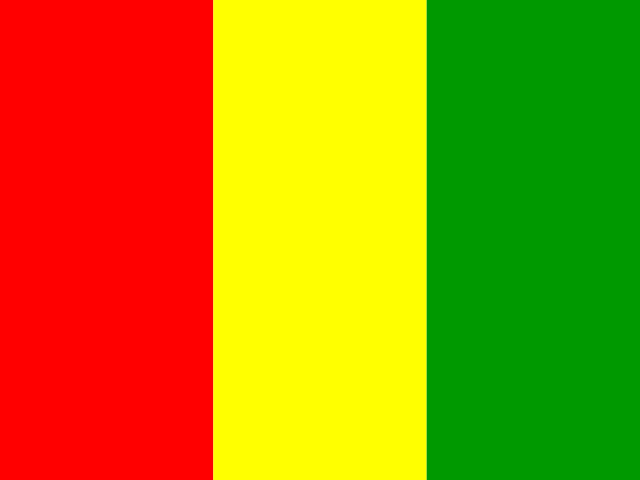
About the Guinean Franc
The current Guinean Franc was introduced in 1985, replacing the Guinean Syli. This was the second time Guinea had used a currency named 'Franc'.
The name 'Franc' is a legacy of French colonial rule.
Interesting Facts
Rich in Bauxite
Guinea possesses the world's largest reserves of bauxite, the main source of aluminum. The mining industry is the primary driver of the economy and the Franc's value.
A History of Two Francs
Guinea has had two different currencies called the Franc, separated by a period (1971-1985) where the currency was called the Syli, meaning 'elephant'.
Portraits of the People
Unlike many currencies, Guinean banknotes feature portraits of ordinary Guinean people, such as a young boy and a woman, representing the nation's human capital.
Historical Timeline
The first Guinean Franc replaces the CFA franc.
The Syli replaces the Franc.
The second and current Guinean Franc replaces the Syli.
Denominations
Banknotes
Coins
Security Features
Quick Facts
- ISO Code
- GNF
- Symbol
- FG
- Numeric Code
- 324
- Subunit
- Centime (1/100)
- Introduced
- 1985-01-01
Central Bank
- Name
- Central Bank of the Republic of Guinea
- Headquarters
- Conakry, Guinea
- Founded
- 1960
- Current Governor
- Karamo Kaba (since 2021)
Economic Data
- Reserve Currency Share
- 0.0%
- Forex Volume Share
- 0.0%
- Inflation Rate
- 8.7%
- Interest Rate
- 11.50%
Exchange Rates



What Affects the GNF Exchange Rate?
Ready to Convert GNF?
Get real-time exchange rates and convert Guinean Franc to any currency.


