
About the Dominican Peso
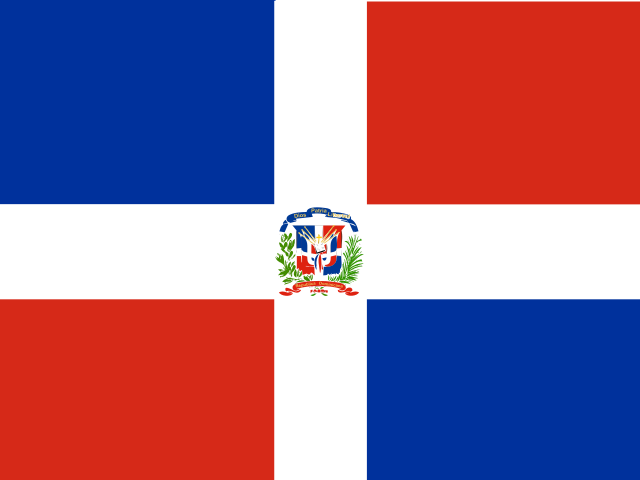
The Dominican Peso was introduced shortly after the Dominican Republic gained its independence from Haiti in 1844. It has gone through several iterations due to inflation.
The name 'Peso' means 'weight' in Spanish, a common currency name in former Spanish colonies.
Interesting Facts
Tourism is Key
The Dominican Peso's value is strongly linked to the country's tourism industry, which is one of the largest in the Caribbean.
Fathers of the Fatherland
The coins feature the effigies of the 'Padres de la Patria' (Fathers of the Fatherland), Juan Pablo Duarte, Francisco del Rosario Sánchez, and Matías Ramón Mella.
Polymer Banknote
In 2022, a new 20 peso oro polymer banknote was introduced to commemorate the central bank's 75th anniversary.
Historical Timeline
The first Dominican Peso is introduced.
The 'Peso Oro' is introduced, pegged to the U.S. Dollar.
The Central Bank of the Dominican Republic is established.
Denominations
Banknotes
Coins
Security Features
Quick Facts
- ISO Code
- DOP
- Symbol
- RD$
- Numeric Code
- 214
- Subunit
- Centavo (1/100)
- Introduced
- 1844-01-01
Central Bank
- Name
- Central Bank of the Dominican Republic
- Headquarters
- Santo Domingo, Dominican Republic
- Founded
- 1947
- Current Governor
- Héctor Valdez Albizu (since 2004)
Economic Data
- Reserve Currency Share
- 0.0%
- Forex Volume Share
- 0.0%
- Inflation Rate
- 3.03%
- Interest Rate
- 7.00%
Exchange Rates

What Affects the DOP Exchange Rate?
Ready to Convert DOP?
Get real-time exchange rates and convert Dominican Peso to any currency.


